
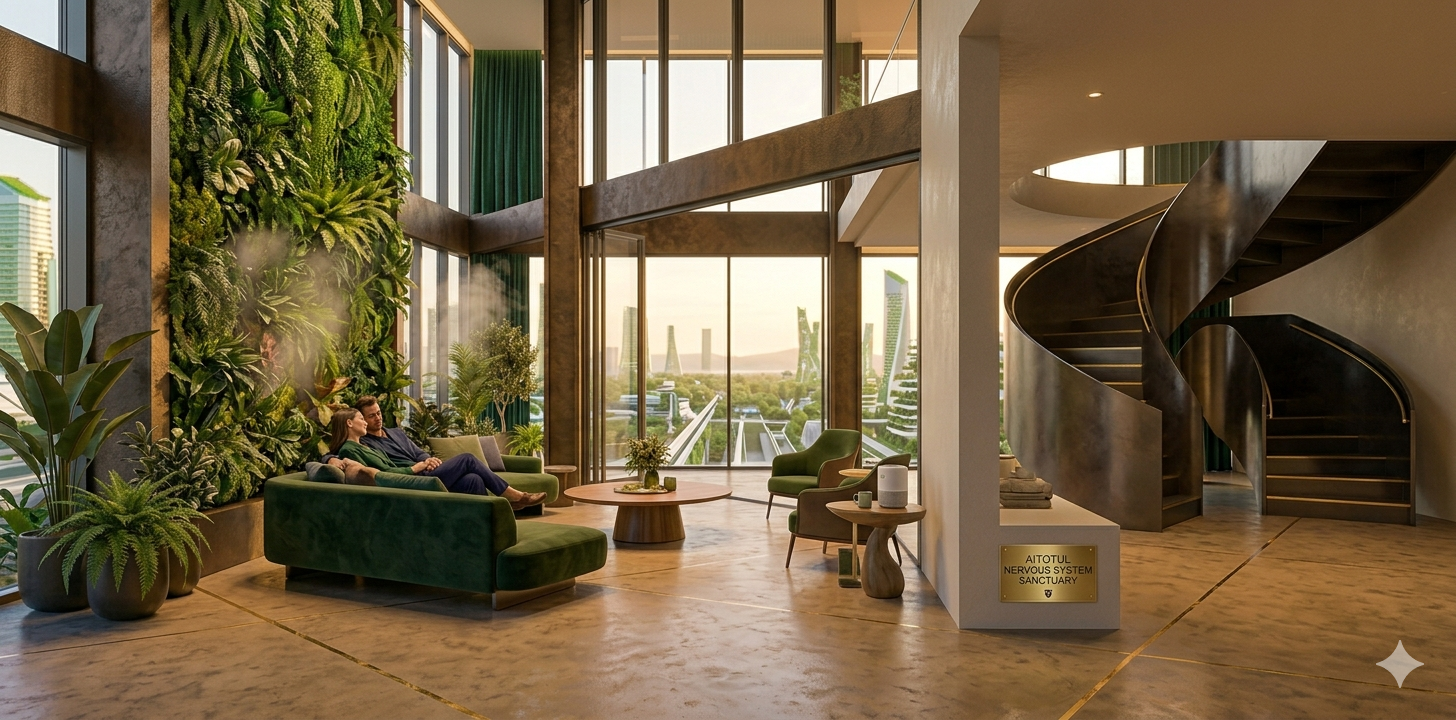
The "Nervous System First" Home: Why 2026 Couples are Prioritizing Vagal Tone in Interior Design
In the hyper-accelerated landscape of 2026, the most valuable currency isn't bitcoin—it's physiological safety. As remote work and digital "always-on" culture continue to blur the lines between professional output and private peace, a new design movement has emerged: The Nervous System First (NSF) Home.
At AiTotul, we are tracking a significant shift in how couples approach their living spaces. It’s no longer just about "Warm Minimalism" or "Sustainable Luxury"; it’s about Vagal Tone Design. This science-backed approach focuses on stimulating the vagus nerve—the "on-switch" for your body’s relaxation response—to ensure that the moment you walk through your front door, your body knows it is safe to heal.
1. Sensory Architecture: Beyond the Visual
For years, interior design was a visual medium. In 2026, it is multi-sensory. Couples are investing in Acoustic Softening, using organic materials like mycelium panels and recycled wool to eliminate "digital hum" and echo.
Why? Because high-frequency background noise keeps the sympathetic nervous system in a state of low-grade "fight or flight." By creating a "Silence Sanctuary," partners can co-regulate their heart rate variability (HRV) simply by existing in the same quiet space.
2. Biophilic Symbiosis and "Green Lung" Living
The 2026 iteration of Biophilic Design goes deeper than just adding a few potted plants. We are seeing the rise of Integrated Green Lungs—living walls that are directly plumbed into the home’s air filtration system.
These installations do more than purify air; they provide the "fractal complexity" that human eyes are evolutionarily wired to find calming. For couples, the shared task of tending to a living, breathing part of the home becomes a grounding ritual that fosters micro-connections throughout the work week.
3. Circadian Precision: The Light-Health Connection
The biggest tech trend for 2026 homes is invisible: Circadian-Logic Lighting. These systems don't just dim; they shift the entire light spectrum based on the couple’s unique biometric data.
Morning: High-intensity blue-enriched light to suppress melatonin and boost cortisol for focus.
Twilight: A transition to "firelight" ambers that signal the brain to begin the wind-down process. This synchronization helps partners maintain a shared "Sleep Sanctuary" rhythm, reducing the social jetlag that often leads to relationship friction.
4. Somatic Nooks and "Safe-to-Feel" Spaces
In 2026, the "open-concept" living room is being broken up by Somatic Nooks. These are small, semi-enclosed spaces designed for nervous system "re-sets."
The Weight Room: Not for lifting, but for feeling. Featuring weighted textures, floor-level seating, and compression furniture that mimics a hug.
The Vagus Corner: Equipped with low-frequency sound-bath technology (vibroacoustics) to help partners decompress after high-stress virtual meetings.
5. Intentional Tech: The "Invisible" Smart Home
Luxury in 2026 means Quiet Technology. The best smart homes are those you can’t see. AI-powered climate control now uses "predictive comfort" to adjust humidity and temperature based on the couple's stress levels, ensuring the environment remains a neutral, supportive backdrop for intimacy.
Conclusion: Designing for Longevity
The NSF Home is the ultimate investment in Relationship Longevity. When your environment actively lowers your cortisol, you have more emotional bandwidth for your partner. You aren't just buying furniture; you are building a bio-available foundation for a life lived in harmony.
At AiTotul, we believe your home should be your body's favorite place to be. In 2026, the most beautiful home is the one that lets you finally breathe.