
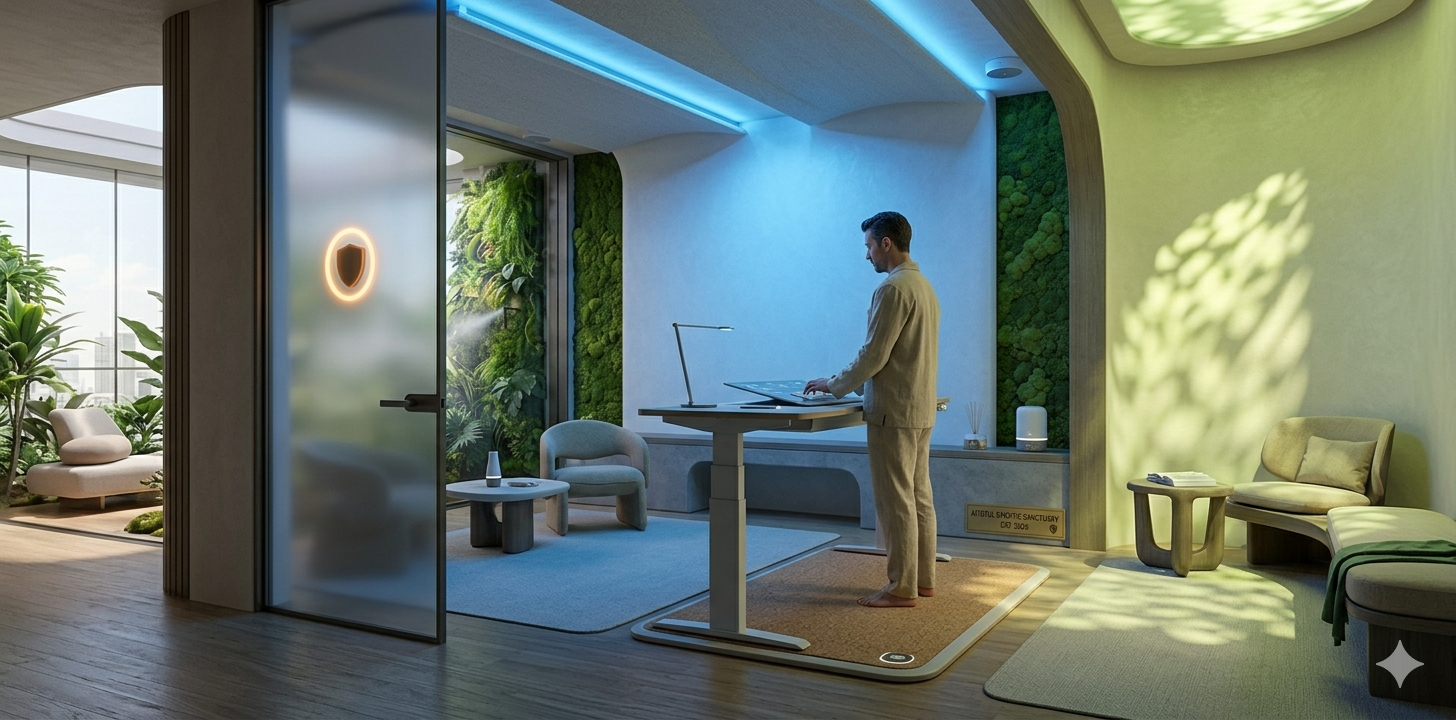
The "Synaptic Study": Why 2026 Couples are Designing "Neuro-Adaptive" Work-from-Home Labs
As the lines between labor and life continue to blur, the standard desk-and-chair setup has become a liability. At AiTotul, we are seeing the rise of the Synaptic Study. This isn't a room for "grinding"; it is a precision-engineered environment designed to keep your brain in a state of high-efficiency "flow" so that you can leave work behind the moment you step out.
This is a critical evolution of the
1. "Cognitive Load" Lighting
In 2026, we don't just dim the lights. Synaptic Studies feature Task-Specific Spectral Lighting.
Deep Work: The room shifts to a high-intensity 5000K blue-white light to suppress melatonin and sharpen focus.
Creative Iteration: The lighting softens to a warm, dappled green-yellow, mimicking the "soft fascination" of the
Micro-Eden Terrace This prevents the "mental friction" common in poorly lit spaces, a concept we've mastered in the
Cognitive Kitchen
2. The "Biometric Door"
The most unique feature of 2026 is the Empathy Indicator. Outside the study door is a subtle LED ring. When the user’s wearable sensors detect high cortisol or a "Deep Focus" brainwave state, the ring glows a soft amber.
This signals to their partner: "I am under high cognitive load; please do not interrupt unless necessary." This physical boundary prevents the "micro-fights" that occur when one partner's work stress spills into the other's
3. Olfactory Anchors
The 2026 study uses Scent-Triggered Productivity. A dry-mist diffuser releases a specific "Work Scent" (like rosemary and lemon) only during work hours.
When the work day ends, the
4. Proprioceptive Desks
Standard standing desks are out. 2026 labs use Dynamic Movement Platforms. While you type, the platform beneath your feet subtly shifts and tilts, requiring minor core engagement.
Much like the floors in the
5. The "Decompression Portal"
Every Synaptic Study ends at a Transition Threshold. This is a small, darkened hallway or alcove between the office and the rest of the home.
It features a quick, 30-second "Acoustic Wash" of white noise—similar to the technology in the
Conclusion: Professional Efficiency, Personal Connection
At AiTotul, we design for the reality of 2026: work is what you do, not who you are. By building a Synaptic Study, you aren't just becoming more productive; you are protecting your